

We often look at monumental achievements—skyscrapers touching the clouds, medical breakthroughs, or economic revolutions—and trace their roots back to universities, laboratories, or boardrooms. But if you look closer, the true bedrock of human capability was laid much earlier. It was poured during a messy afternoon of finger-paints, during endless questions about why the sky is blue, and on colorful preschool carpets where children first learned to share.
Early education is not merely a precursor to “real schooling.” It is the architectural blueprint of the human mind, which is why exploring powerful early education quotes can offer profound insights.
To capture the depth of this critical phase, we have curated a fresh, deeply reflective collection of early education quotes that look past the clichés. Whether you are an educator shaping young lives or a parent navigating the wondrous chaos of toddlerhood, these powerful early education quotes and perspectives celebrate the quiet magic of early learning.
Top 10 Early Education Quotes with Explanation
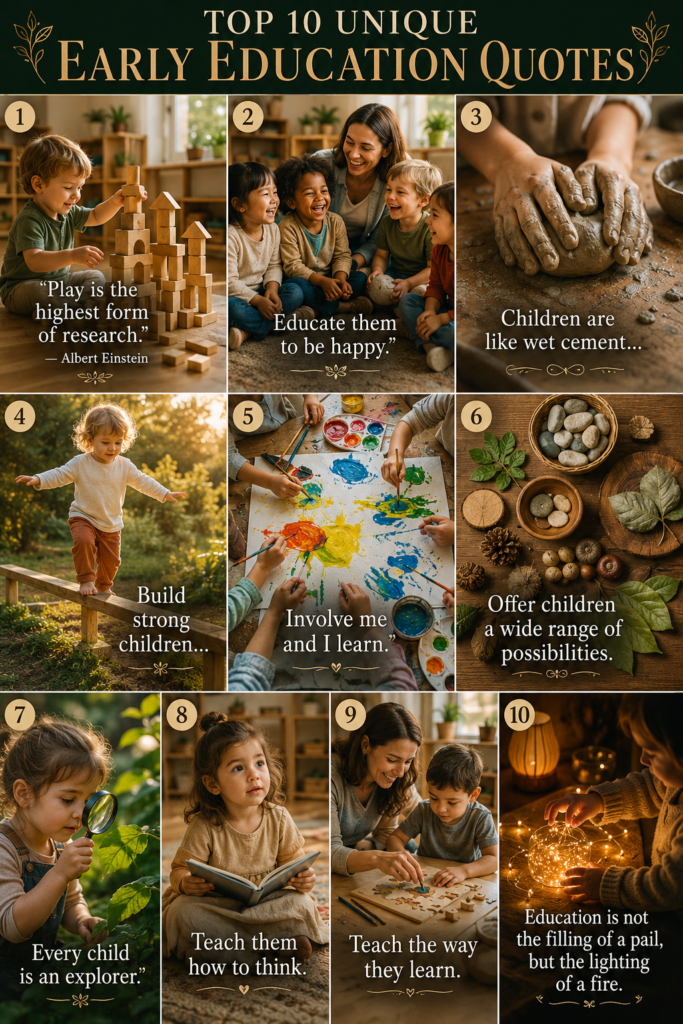
While early learning happens through every touch and sound, some thinkers, educators, and writers have perfectly captured its core philosophy. Here are 10 profound early education quotes, broken down to reveal the deep wisdom behind them:
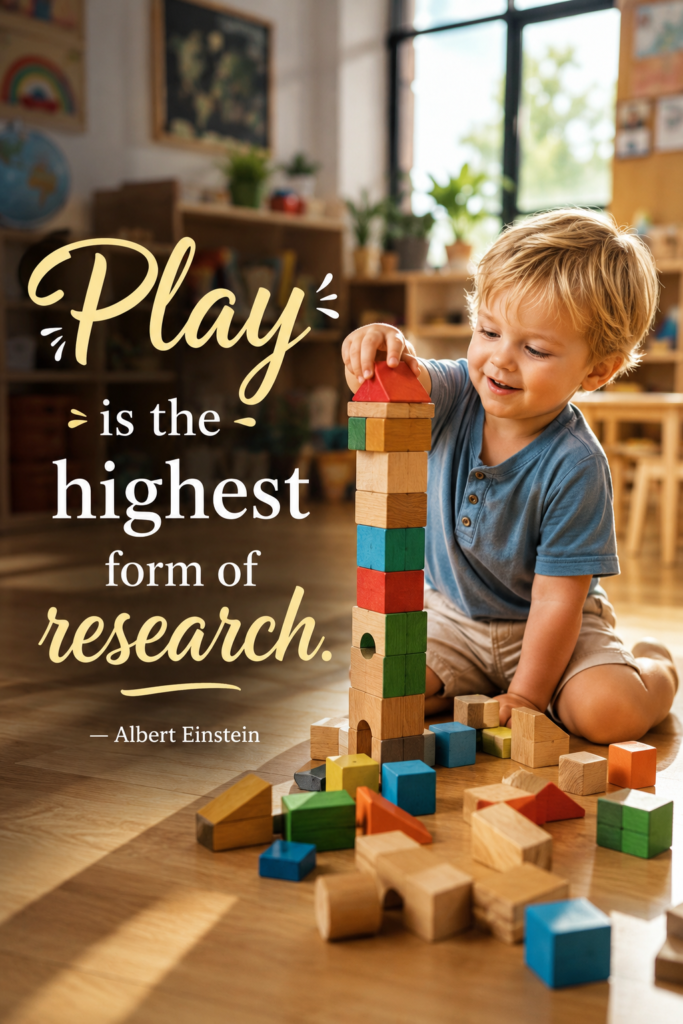
1. “Play is the highest form of research.” — Albert Einstein
- The Explanation: We often separate “play” from “learning” as if they are two different things. Einstein reminds us that for a young child, exploring, experimenting, and getting messy is actually high-level scientific investigation. When children build block towers or mix sand and water, they are testing the laws of physics.
Read the full guide on Positive Parenting here
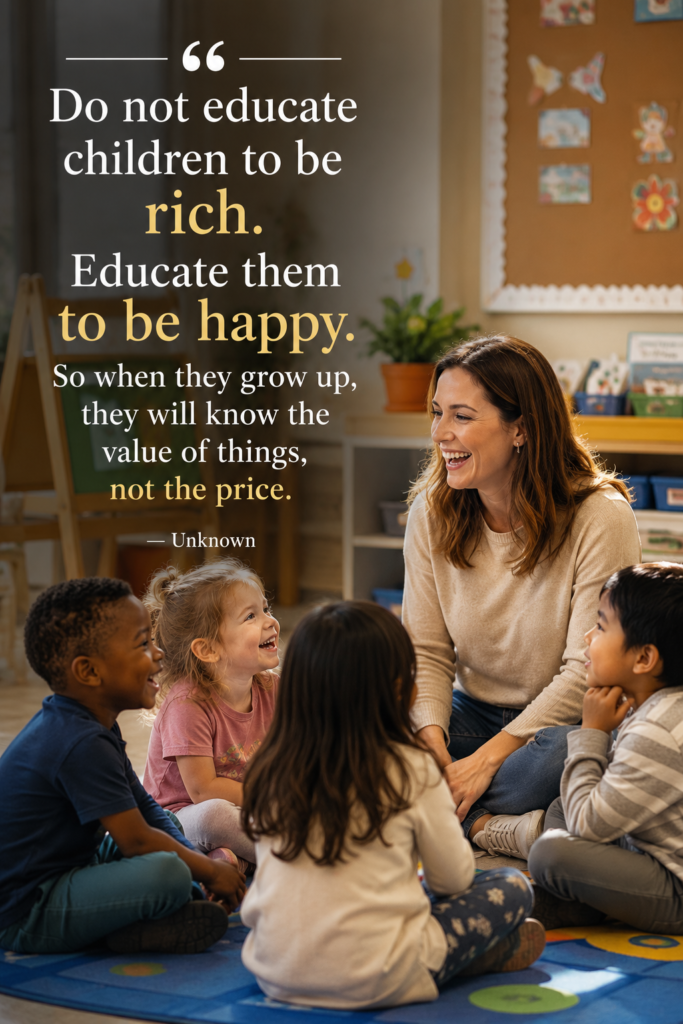
2. “Do not educate children to be rich. Educate them to be happy. So when they grow up, they will know the value of things, not the price.” — Unknown
- The Explanation: Modern early education is frequently pressured by academic rat races. This quote serves as a vital anchor for parents and teachers, reminding us that preschool and kindergarten should prioritize emotional well-being, character building, and joy over early performance metrics.
Smart Parenting Strategies for Today’s Digital Era
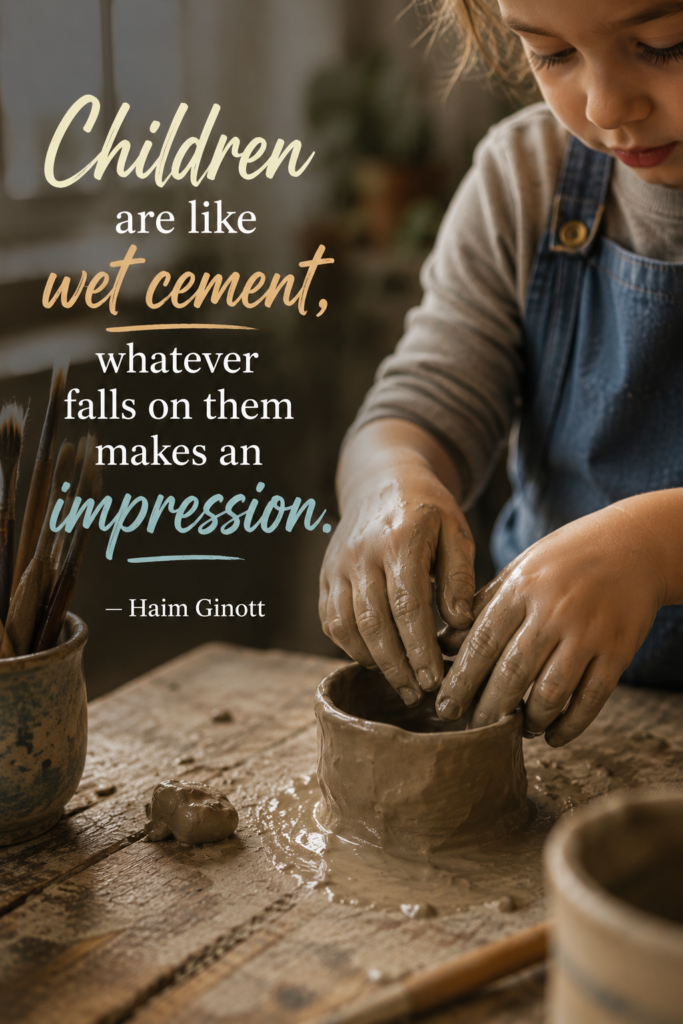
3. “Children are like wet cement, whatever falls on them makes an impression.” — Haim Ginott
- The Explanation: This powerful metaphor highlights the delicate and impressionable nature of early childhood. Every word spoken, every reaction to a mistake, and every environment we provide leaves a permanent mark on a child developing self-esteem and worldview.
Want to make sure the right impressions stick during your child’s most crucial formative years? Click here to discover the 30-Day Gentle Parenting Guide and build a loving foundation today.
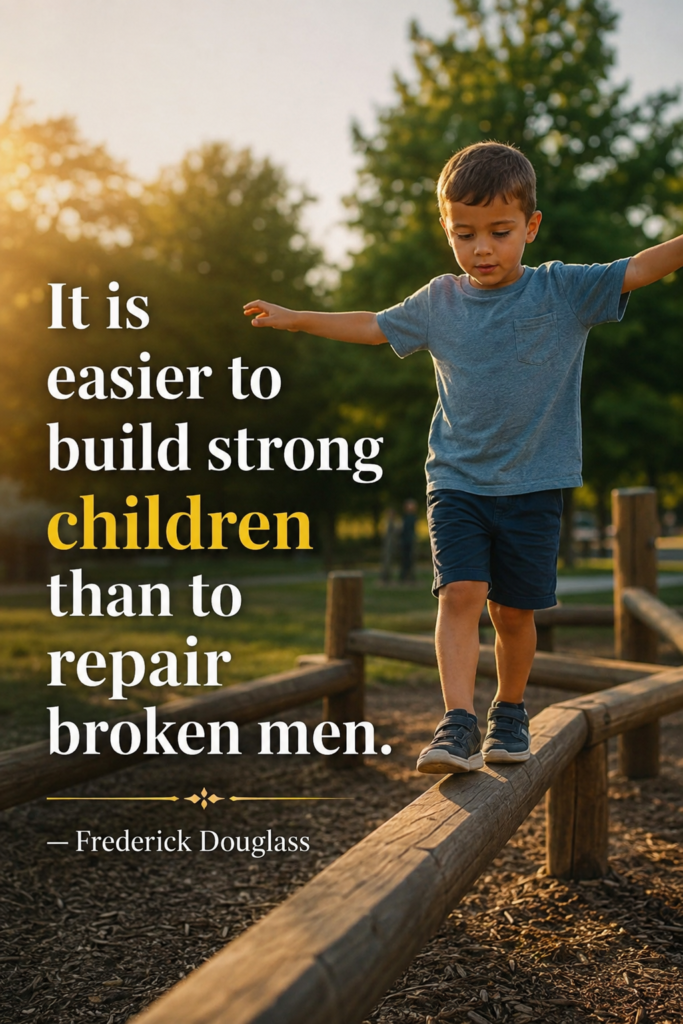
4. “It is easier to build strong children than to repair broken men.” — Frederick Douglass
- The Explanation: Focusing resources, care, and attention on early childhood education is an investment in prevention. When we instill confidence, emotional regulation, and curiosity early on, we prevent struggles with mental health, learning resistance, and self-doubt later in life.
Don’t just hope for success—build it. Learn the practical steps to help your child reach their full potential and grow into a strong, successful adult.
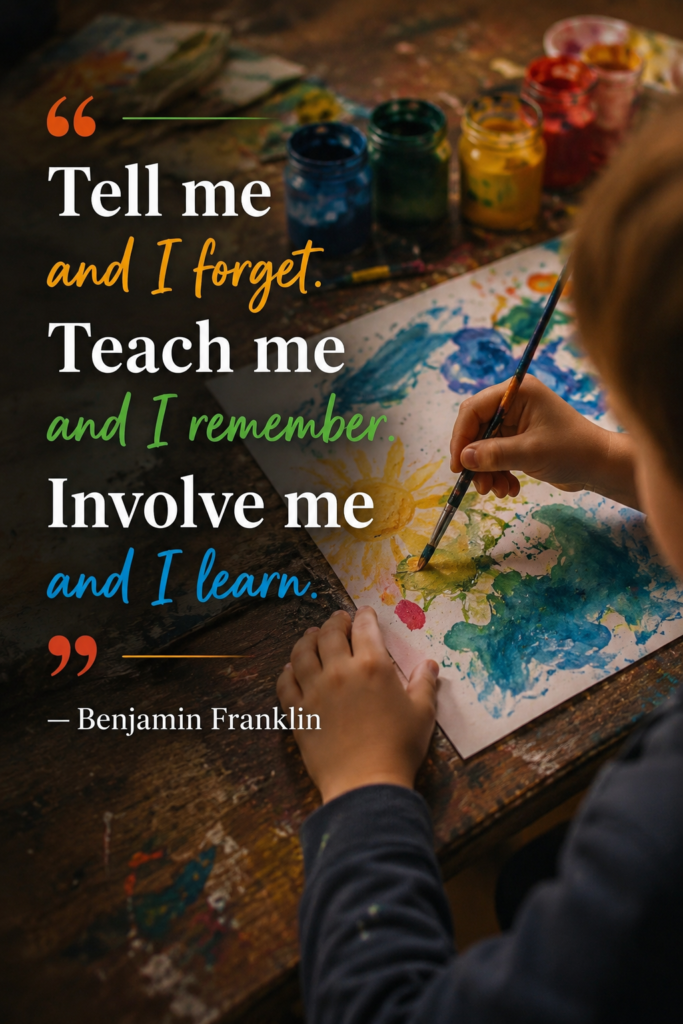
5. “Tell me and I forget. Teach me and I remember. Involve me and I learn.” — Benjamin Franklin
- The Explanation: Rote memorization and passive listening do not work well for young minds. Early education thrives on hands-on experiences. Children need to touch, move, manipulate objects, and participate actively to truly grasp concepts.
Want to understand how your child connects with the world through touch, comfort, and active engagement? Discover The Comfort Attachment Guide to help your child build emotional independence naturally.
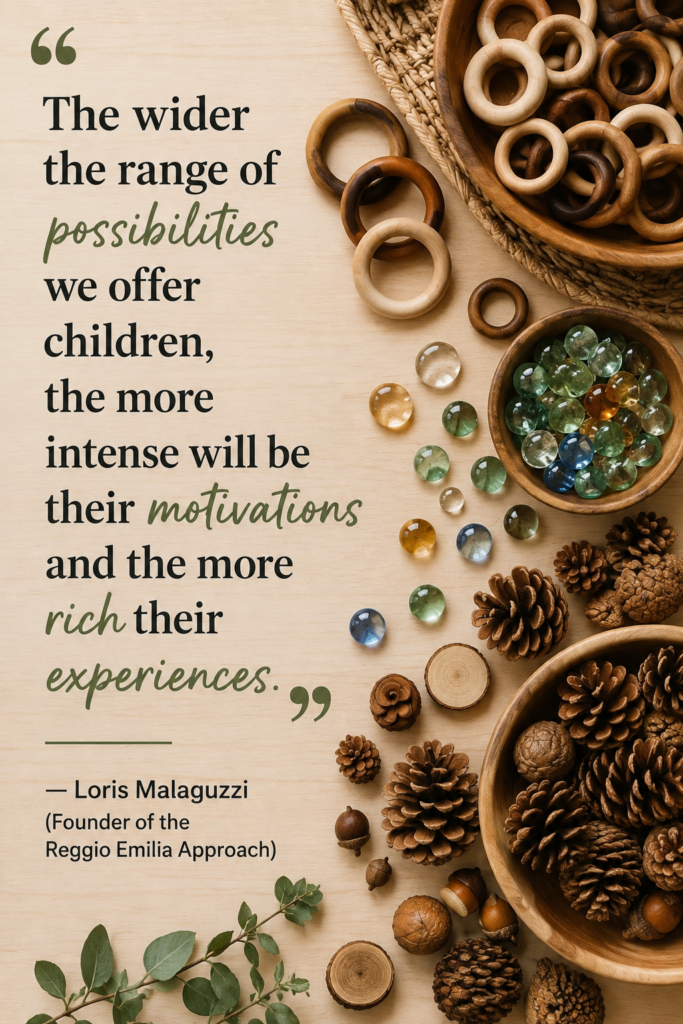
6. “The wider the range of possibilities we offer children, the more intense will be their motivations and the more rich their experiences.” — Loris Malaguzzi (Founder of the Reggio Emilia Approach)
- The Explanation: This quote emphasizes the importance of open-ended environments. When classrooms and homes offer diverse materials—from art supplies to natural items—children direct their own learning based on their unique curiosities.
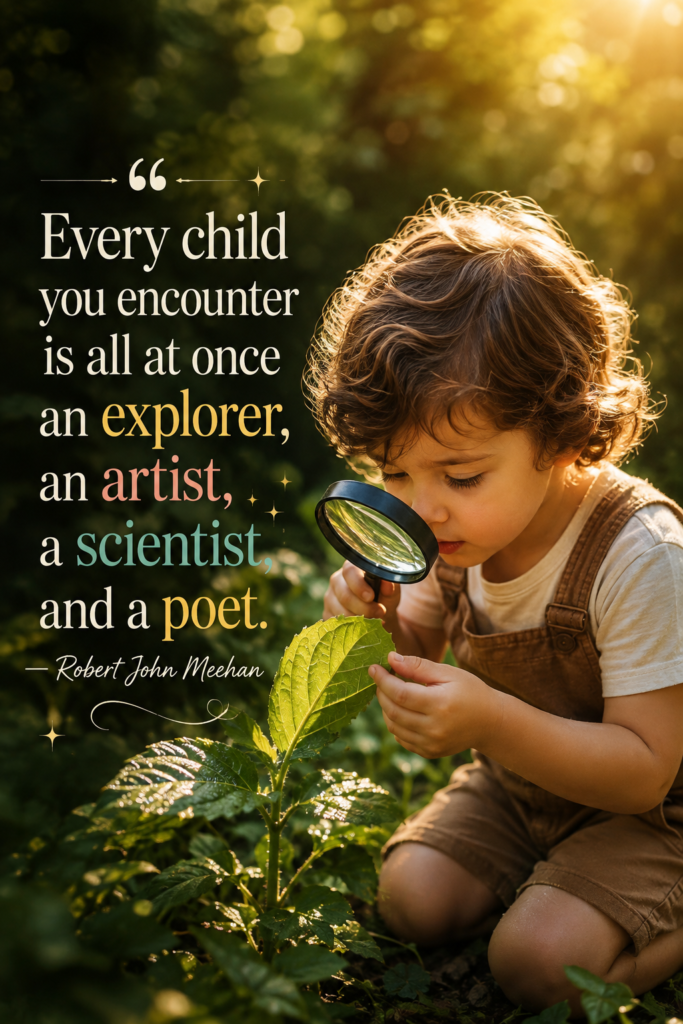
7. “Every child you encounter is all at once an explorer, an artist, a scientist, and a poet.” — Robert John Meehan
- The Explanation: Adults tend to underestimate how much depth exists in a child’s mind. Children do not just look at a bug or a cloud; they experience it with total wonder. Early education is less about filling an empty vessel and more about keeping these natural identities alive.
Ensure your young athlete is fueled for success, not just in the pool but in their development. Get the Youth Swimmer Nutrition Guide here.
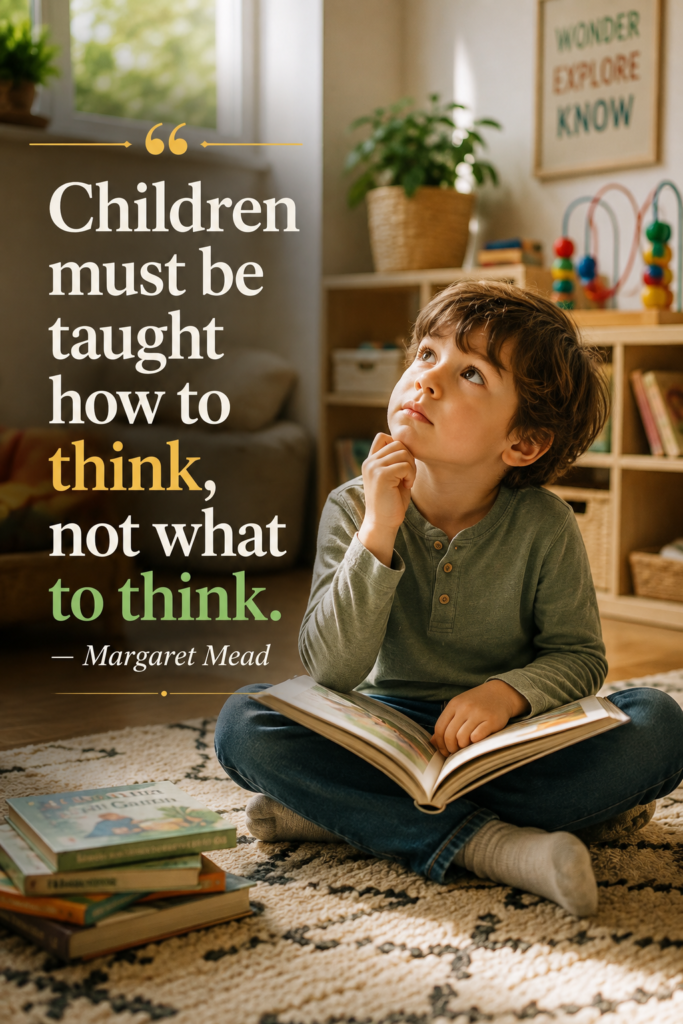
8. “Children must be taught how to think, not what to think.” — Margaret Mead
- The Explanation: True education is about critical thinking and problem-solving, not regurgitating facts. In early childhood, this means encouraging children to ask “why” and allowing them to figure out solutions on their own rather than giving them immediate answers.
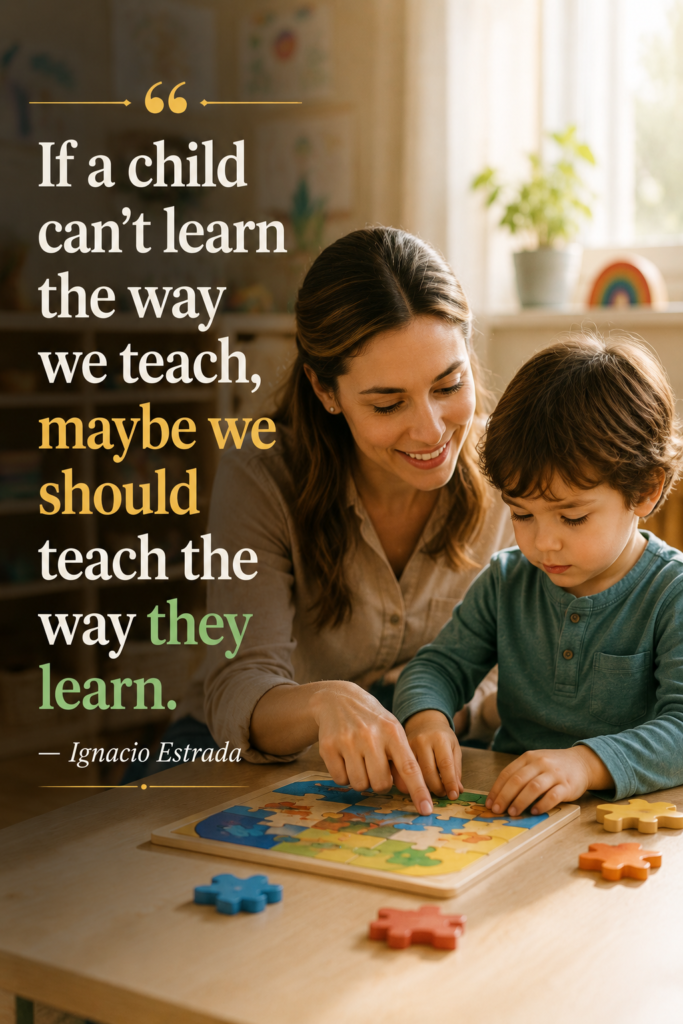
9. “If a child can’t learn the way we teach, maybe we should teach the way they learn.” — Ignacio Estrada
- The Explanation: Every child has a distinct learning pace and style—some are visual, some kinesthetic, and some auditory. This quote is a powerful reminder for educators and parents to adapt to the child, rather than forcing a one-size-fits-all mold onto a unique mind.

10. “Education is not the filling of a pail, but the lighting of a fire.” — William Butler Yeats
- The Explanation: Perhaps the ultimate philosophy of early learning. We shouldn’t view a preschooler’s mind as a container that needs to be packed with facts before kindergarten. Instead, early education is about sparking a lifelong passion for discovery that burns brightly long after formal schooling ends.
Beyond the ABCs — The True Meaning of Early Learning
We live in a culture obsessed with early acceleration—teaching toddlers to read before they can run or pushing flashcards onto four-year-olds. But true early education is about igniting a lifelong fire, not filling a storage container.
“An early childhood classroom should not feel like a waiting room for the real world; it is the most real world a child will ever experience, unfiltered and alive with wonder.”
“Before a child can write their name in ink, they write their character in sand, in mud, and in the freedom of unhurried play.”
“The goal of early education is not to manufacture a prodigy, but to preserve the sacred, fearless curiosity that adults spend the rest of their lives trying to recover.”
- The Takeaway: When we measure early education by test scores, we miss the point. The greatest lessons learned in early childhood are resilience, empathy, and the courage to make mistakes.
The Unsung Architects — Quotes for Early Childhood Educators
When searching for the right words to inspire teachers, early education quotes play a vital role. Whether you need a short saying for a classroom poster or deep wisdom for a presentation, these carefully selected early education quotes provide the exact perspective you require. Every great educator knows that collecting and sharing meaningful early education quotes can completely transform how we view preschool learning.
Teachers of young children do not just teach subjects; they manage entire ecosystems of imagination, emotion, and raw energy. Their work requires a rare blend of infinite patience and fierce dedication.
“A kindergarten teacher holds the fragile compass of a child’s worldview, pointing it gently toward kindness before math, toward wonder before rules.”
“You cannot rush a seed to sprout by shouting at the soil. Early childhood educators understand that growth is a quiet, invisible rebellion against ignorance.”
“To teach a five-year-old is to practice radical optimism. Every single day, you are planting seeds in a garden you may never return to see bloom.”
- Why This Matters: Early educators build the emotional safety nets that allow children to take intellectual risks later in life. Their impact is exponential, rippling through decades we will never see.
The Sandbox Partnership — Quotes for Parents
Education does not begin at the school gate; it starts at the kitchen table, in the grocery store aisle, and during bedtime stories. Parents are a child’s first and most enduring teachers.
“The most profound lessons a child learns from a parent are caught, never taught. They learn how to love the world by watching how you look at a rainy afternoon.”
“A home filled with messy hands, open-ended questions, and patient listening is the richest preschool a child could ever attend.”
“Do not worry that your child is not listening to you; worry that they are watching everything you do. Early education is a mirror long before it is a textbook.”
Top 10 Early Childhood Education Quotes
Here is another fresh, completely unique list of 10 hand-curated early childhood education quotes specifically focused on early childhood education, ensuring zero repetition with your previous sections.
1. “Early childhood is not a race to see how quickly a child can read or write, but a sacred journey to see how deeply they can wonder.” — Joan Almon
- The Explanation: This quote pushes back against the modern rush to accelerate toddlers into premature academics. It reminds us that the true win of early childhood is preserving a child’s capacity for awe, imagination, and deep engagement with the world around them.
2. “The best preschool classroom is one where the floor is a little messy, the air is full of questions, and the children feel entirely safe to try and fail.” — Reggio Emilia Philosophy Principle
- The Explanation: Perfection has no place in early learning. True growth happens when children are free to experiment with materials, make mistakes, and test their theories without the pressure of keeping things neat or correct.
3. “Children learn as they play. Most importantly, in play, children learn how to learn.” — O. Fred Donaldson
- The Explanation: Play is often dismissed as mere entertainment by adults, but it is actually the foundational training ground for problem-solving, emotional regulation, and cognitive flexibility. When a child plays, they are mastering the art of acquiring knowledge.
4. “There can be no keener revelation of a society’s soul than the way in which it treats its children in their earliest years.” — Nelson Mandela
- The Explanation: Mandela highlights how critical early childhood care and education are on a macro level. Investing time, patience, and resources into our youngest learners is the ultimate measure of a compassionate and forward-thinking culture.
5. “In the minds of young children, facts are fluid, but wonder is absolute. Our job is to protect the wonder.” — Rachel Carson
- The Explanation: Small children don’t care about memorizing dry facts; they care about how things feel, sound, and move. Early education should feed that natural sense of mystery rather than smothering it with rigid curriculum checklists.
6. “To a child, love is spelled T-I-M-E. Nowhere is this truer than in the early years of discovery.” — Dr. Sigman
- The Explanation: No high-tech toy or expensive educational app can replace human presence. Early childhood education relies heavily on the undivided attention, patient listening, and shared experiences provided by caring adults.
7. “A child’s hand is the tool of their emerging intellect. When they touch, build, and mold, their brain begins to map the world.” — Maria Montessori
- The Explanation: Kinesthetic learning is everything in the early years. Montessori reminds us that children cannot learn purely through passive listening; they need to use their hands to manipulate objects to truly understand how reality works.
8. “The seeds of lifelong resilience are planted in sandbox compromises and playground resolutions.” — Fred Rogers (Mister Rogers)
- The Explanation: Long before children read about conflict resolution in textbooks, they learn it the hard way in the sandbox—sharing toys, negotiating turns, and handling disappointment. Early childhood settings are the world’s first social laboratories.
9. “We must treat early childhood education not as a babysitting service, but as the most critical department of human engineering.” — James Heckman (Nobel Laureate Economist)
- The Explanation: Backed by economic and neurological science, this perspective proves that investing in early childhood yields the highest return on human potential, shaping emotional stability and cognitive capacity for life.
10. “Give them roots to grow through deep security, and wings to fly through fearless exploration.” — Imtiaz Dharker
- The Explanation: The ultimate paradox of early education: children only develop the courage to explore the unknown world when they know they have a safe, unconditionally loving anchor waiting for them at home and in the classroom.
Where Movement Meets Mind
Physical movement, spatial exploration, and tactile discovery are the engine rooms of early brain development. When a child runs, jumps, blocks-builds, or paints, their neural pathways light up in ways screens can never replicate.
“A child’s brain does not grow by sitting still; it expands with every jump over a crack in the pavement and every tower of blocks that crashes to the floor.”
“Play is not a distraction from learning; it is the highest, most rigorous form of early research a human being can undertake.”
How to Apply These Insights in Daily Life
Quotes are wonderful to read, but their true power lies in how they shape our daily routines. If you want to honor the philosophy of early education:
- Slow Down the Clock: Give children the gift of unstructured time. Boredom is often the fertile soil where creativity takes root.
- Celebrate the Process, Not Just the Product: Instead of praising a finished drawing, ask the child to tell you the story behind it.
- Create Safe Spaces for Failure: Whether it’s a spilled cup of juice or a puzzle piece that won’t fit, treat mistakes as fascinating puzzles rather than disasters.
Conclusion
As you reflect on the journey of guiding young minds, remember that every small lesson lays the foundation for a lifetime of growth. Exploring meaningful early education quotes reminds us of the profound impact that patience, play, and curiosity have on a child’s earliest years. Whether you are a dedicated teacher or a loving parent, keeping these timeless early education quotes close at hand will continue to inspire your daily approach. Ultimately, sharing and cherishing these early education quotes helps keep the passion for true learning alive, ensuring that every child’s potential is fully unlocked.
Final Thoughts
Early education is a quiet revolution. It happens away from the headlines, in classrooms smelling of glue and construction paper, and in living rooms cluttered with building blocks. By respecting the depth of these formative years—and the incredible adults who guide them—we give children the greatest gift of all: a mind that stays curious for a lifetime.
What does early education mean to your family or classroom? Share your favorite thoughts or reflections in the comments below!
Affiliate Disclosure: Some of the links in this article are affiliate links. If you make a purchase through them, we may earn a small commission at no extra cost to you. Read our full Affiliate Disclosure & Recommended Resources for more details.
Don’t Forget to Check out Social Media
Pinterest, Linkedin, Reddit, Facebook, Tumblr, Medium.